Simple Steps of Teaching Phonics and Reading
How to Teach a Child to Read With Phonics
My outset baby, Phonics Hero, had already taught thousands of children how to read. Merely the game changed when I had my 2d baby: my very own child! Now the everyday practicalities of how to teach a child to read with phonics began to play out in my own home.
My 3.v year one-time daughter, Nieve, is now reading simple words on her own. My mum friends are all clamouring to know – what'due south our secret? And so here it is, my footstep-by-step recipe for how to teach a child to read with phonics.
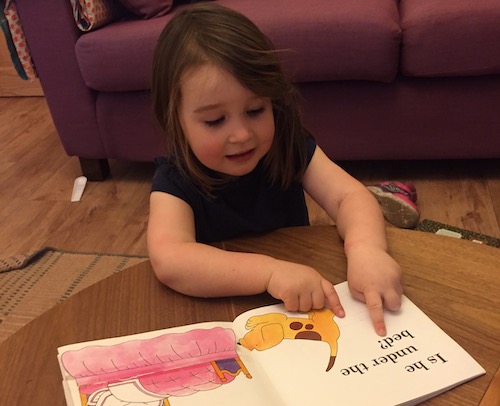 Nieve reading some of the simple words from 'Where'due south Spot?'
 From the Outset:
Plant nursery rhymes
Knowledge of nursery rhymes enhances children's phonological sensitivity which in turn helps them to larn to read."
Bryant, "Nursery Rhymes, Phonological Skills and Reading", 1989.
Phonological awareness is the power to recognise and 'play with sounds' in spoken linguistic communication. If a child is good at playing with sounds in spoken words, they will easily transition to manipulating sounds in written words. If you want to practice a deep dive into this skill you tin can read up on it here. The main signal is: nursery rhymes – do lots of them!
Stories EVERY night
By reading to your kid, you will be enhancing their phonological sensation skills. Await out for those stories jam-packed with rhyme. In improver to enhancing your child's phonological awareness skills, you volition also be demonstrating what a skillful reader looks similar: pitch, tone, emphasis and the pleasure that comes from reading!
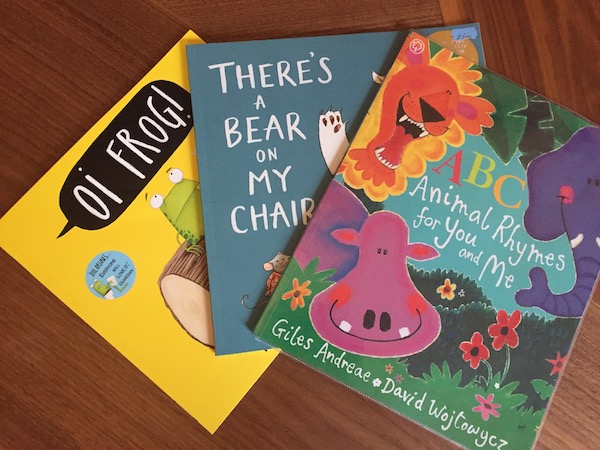 Our electric current bedtime favourites incorporate LOADS of rhyme – so useful for priming a kid for reading!
 Step 1: Introducing the Sounds:
Play with rhyme
When Nieve turned iii we began step 1 of reading, rhyming. The timing is unlike for every child, so if your child is resistant, don't button it. But come back to information technology later. The last thing yous desire to do is plough them off reading at an early age.
As Nieve and I would walk to swimming lessons, we'd play the rhyming game:
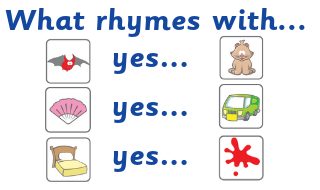
If your child comes up with nonsense words which rhyme, for example 'dat' rhyming with 'cat', that's perfectly acceptable – information technology all the same demonstrates they understand the concept.
Start identifying initial sounds of words
Before your child can motion onto reading with letters, they need to understand that there are unique sounds in words, for case 'cat' is not one audio, but is made upward of /c/, /a/, and /t/ (in phonics we denote a audio similar this: /south/).
Some ideas:
- What does your proper name first with? (My girl always enjoys telling me what her friend's names start with.)
- As you pull out the calendar week's shopping – What's the first sound of each of these vegetables?
- I spy with my picayune eye something outset with /c/? (A groovy ane for a auto journeying.)
- I went to the shops to buy a dolphin! And so your child repeats it, adding some other /d/ particular on the end. Keep calculation to the /d/ shopping list until you are completely stuck!
Step 2: Oral Blending:
Oral blending is the power to glue sounds together to produce a discussion. As a pre-reader, information technology'southward done without letters and simply the sounds. I would say to my daughter, "what am I saying /ch/ – /air/?" Watch us demonstrating:
Information technology'due south critical to master this phase before moving onto anything more complicated. I tried to progress Nieve onto blending with letters also early, and we had a large set-back. And so we put the magnetic letters away and carried on orally blending for several months longer. This is a disquisitional foundational skill. Stick with it.
Step 3: Innovate the Letters and their Sounds:
Earlier I go into how to teach a child to read with phonics, a comment on readiness from our Educational Psychologist (too Nieve's granddad!).
Like learning to walk, learning to read happens for children at unlike times. Nieve was an early on talker and a girl – 2 major advantages in learning to read.
If y'all are pedagogy a child to read at home, you lot don't want to make it into a negative experience. Keep it light, don't be too pushy and be willing to give up and come up back to it later."
Michael Wood, Educational Psychologist
Firstly, you lot'll desire to purchase some lowercase magnetic messages (stay away from uppercase – information technology will only confuse things).
The get-go step is to accept 4 unmarried alphabetic character-sounds and learn that the letter 'due south' represents /s/. We did that for the start iv sounds:

Some of the games we played:
- Just pointing to the letter on the fridge and saying the sound.
- Mummy hiding 1 and Nieve telling me what was missing.
- Nieve beingness the teacher and mummy getting lots wrong (she loves telling me the answer).
- Blind-folding Nieve and request her to feel and find the /south/ audio. As expected, it was my plow afterwards – and I got oh then many of them wrong!
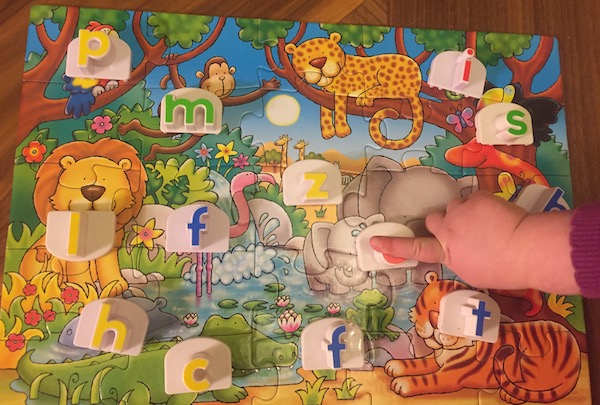 We got creative with practising the letter sounds – matching the get-go sound of the animal with it'due south letter of the alphabet.
 If your child gets stuck on a particular sound, give them an object on which to anchor information technology, something they are familiar with, such as a relation or a favourite toy. Neither for love nor money could Nieve think the /c/ sound when I presented her with the 'c' letter of the alphabet. I would remind her "it'due south like mummy's proper noun" (my name begins with a 'k', but right now it doesn't matter – it's the same sound as the letter 'c').
Once she was telling me these sounds as quickly as she equally she could tell me her own name, I introduced some other four sounds, bringing the total to eight.

Step four: Moving onto Blending Her First Words:
Once she had eight sounds under her belt and her oral blending was quick, Nieve was ready to motility onto blending with letters. Blending is the power to glue sounds together to produce a discussion (for those who want more information on blending – read our blog mail service here). It's critical that a child learns to blend early in the process (lots of early learning centres practice all 26 letter sounds of the alphabet before moving onto blending, which can and should exist washed much earlier).
When Nieve first composite, it was like all my Christmases had come at once! I managed to capture the starting time time she blended:
Did you find how I simply changed the start sound to begin with? This lessened the "cognitive load" (how much information a child can handle in one get). Recollect of learning to read similar learning to bulldoze. My beginning driving lesson wasn't a three-point-plough but driving in a straight line downward the road. Also, with learning to read, we want to ease a child in, scrap by bit.
Here is a wordlist using those beginning eight sounds. Stick to one group at a time, doing lots of repetition before moving on to the next group.
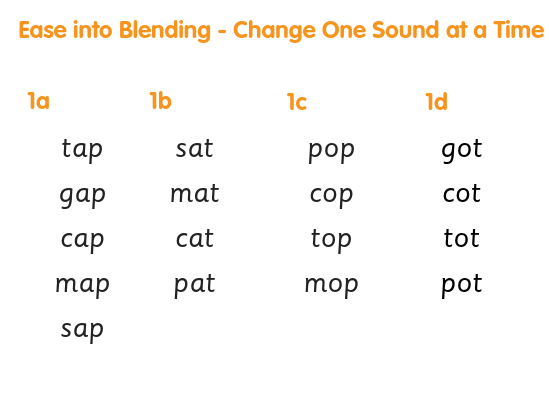 Practise blending with each of these word groups.
 Step 5: Practice, Exercise, Practice!
When learning to drive, one time you had the nuts, it became about clocking hours on the road – practising and applying what yous learned. Likewise, practising is the adjacent pace when you teach a kid to read.
Practice with worksheets
Nieve loved practising her blending skills using our worksheets; she'd do the aforementioned one over and over again. She loved them because she had success really rapidly; they were single words and those which just used the sounds she knew.
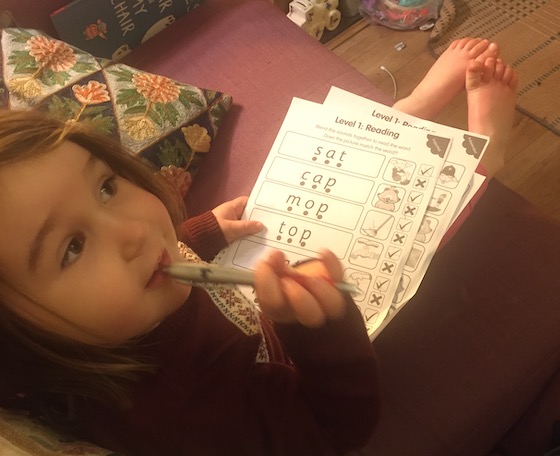 Nieve practising her blending skills with our worksheets.
 You tin become your hands on the whole set up of over 200 worksheets for only The states$20. That volition last your child until they are seven!

All iii parts covering levels 1 – 26 in Phonics Hero. On completion of payment y'all volition be able to download the whole set for printing at home.
218 worksheets covering:
- the sounds
- reading
- spelling
- catchy words
- sentences
Usa$20 Approximately AU$27 / HK$150 / £15 at the time of writing.
Play Phonics Hero
Phonics Hero has 850 online games which systematically accept a kid through reading and spelling with the 44 sounds of the English language, all wrapped up in an exciting superhero storyline. It builds children'due south skills: from the sounds, to reading single words, to spelling and – finally – conquering sentences.
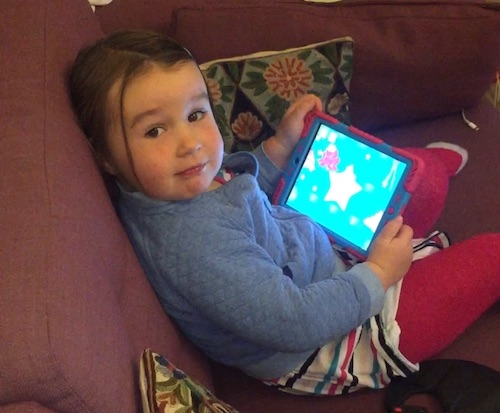 Nieve playing Phonics Hero on the iPad app.
 Take a get with your child. You can become a free seven day trial of Phonics Hero here:
Start Your Free seven 24-hour interval Trial
You don't want to mitt the kid your tablet and just let them 'go for information technology' – like yous would a kid's game. Exist on hand to piece of work through the words if they go stuck. Here is Nieve playing the first blending game:
Did you notice how on the 3rd give-and-take, I corrected her when she tried to estimate? I don't desire her to go into the bad addiction of guessing at words: stiff readers don't guess.
Use decodable books
Decodable book are texts that comprise specific knowledge which the students accept been taught. This knowledge consists of phonics (letter sound lawmaking), the blending strategy and eventually irregular, high frequency words often known as tricky words.
Santina DiMauro, Primary Schoolhouse Teacher
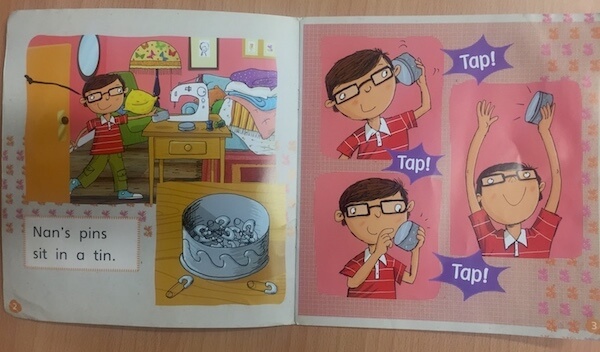 Simplicity is key with early decodable readers.
 By using a decodable book your child will get to show off their reading skills – just like a real reader! If you are searching for some books to buy, ensure they start with single words or very, very bones sentences. Speech Pathologist, Alison Clarke has a great listing here.
And They're Off…
One time your child starts achieving success from the process of learning to read, they'll want to do it over again and again. Remember, when you teach a child to read you demand to be really precise with the words you are expecting them to read. Phonics Hero will hold your hand through the introduction of each grouping of sounds, so stick to what nosotros introduce and when we practise it. I made this video to briefly explain the systematic, synthetic phonics approach that we utilize:
What I Learned Most How to Teach a Kid to Read at Home
Firstly, it'south important to say that this hasn't been a straightforward path. Because of what I do every day, I knew the roadmap, merely Nieve didn't always stick to my directions! What the process really highlighted to me is that you can't force readiness – be prepare to give upwards and come back to it later. Secondly, I tin't emphasise enough the importance of pre-reading skills – when oral blending clicked, everything came together. And finally, it's not nigh a 'phonics lesson', merely finding the opportunities to larn while she eats her /p/, /a/, /southward/, /t/, /a/.
Good luck! I'd love to hear your experience in the comments below.

Author: Katherine Wood
Katherine is the CEO and co-founder of Phonics Hero. She has worked in synthetic phonics for over 15 years, working with hundreds of schools to back up them in their implementation of synthetic phonics.
Source: https://phonicshero.com/how-to-teach-a-child-to-read/
0 Response to "Simple Steps of Teaching Phonics and Reading"
Post a Comment